On October 5, 2026, TradeSun sued OpenAI in a California federal court over the name of GPT-6 Astra. TradeSun says its earlier ASTRA mark identifies AI software for trade-document work and that OpenAI's much larger launch could make customers assume TradeSun copied or is connected to OpenAI. This is a new allegation, not a finding of infringement. For founders launching an AI product, the dispute puts trademark clearance, product naming and evidence of market use on the same planning calendar. Bloomberg Law reported the filing and both sides' initial positions.
What is established about the ASTRA name
A USPTO public proceeding record identifies TradeSun as owner of US registration No. 6,746,198 for ASTRA. The registration certificate reproduced in that record states that the standard-character mark registered on May 31, 2022 for software-as-a-service using AI for document classification, data extraction and processing. It records May 2021 first-use claims. Registration is important evidence of rights, but the exact scope and any infringement remain questions for the court.
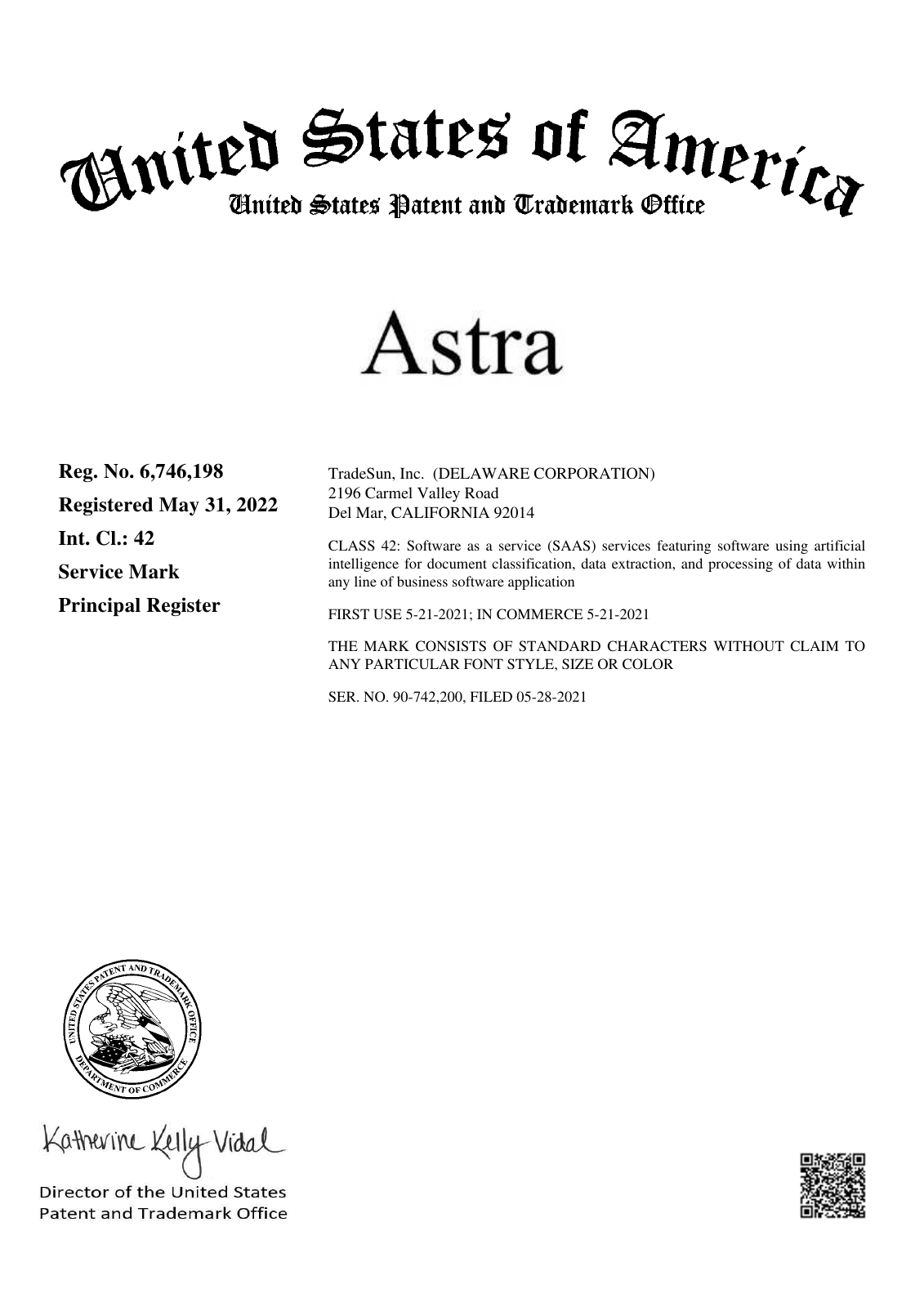
USPTO registration certificate reproduced in a public TTAB file. The certificate establishes registration details; it does not decide the new lawsuit.
TradeSun's current website presents Astra as agentic AI for verifying shipment documents, fraud risks and trade compliance. OpenAI's official product announcement uses GPT-6 Astra for its AI model. The shared word is clear. Whether customers understand those uses as related, and whether any customer is likely to assume affiliation, requires evidence about the actual services, buyers, sales channels and presentation of the marks. A product page alone cannot answer those questions.
Why TradeSun calls this reverse confusion
Ordinary trademark confusion is often described as a smaller newcomer appearing to trade on an established brand. TradeSun alleges the opposite commercial direction: a later, much more visible user could overwhelm an earlier user, so buyers might mistakenly think the earlier company is an OpenAI partner or imitator. Law360 independently covered that theory. The phrase “reverse confusion” describes an alleged path to customer error; it does not create automatic liability because one party is bigger.
OpenAI told Bloomberg Law that the complaint lacks merit. At this early stage there is no reported ruling on confusion, priority, damages or an injunction in this case. TradeSun seeks relief that includes removal of the name, according to the report, but a request in a complaint is not an order. A business evaluating the dispute should follow docket No. 3:26-cv-11360 rather than treating the requested remedy as the likely outcome.

TradeSun mark shown on its official website. This identifies the company and is not a depiction of the separate ASTRA word registration.
A registration is a starting point, not a clearance report
The USPTO's likelihood-of-confusion guidance explains why search results must be assessed for both mark similarity and related goods or services. Identical words can sometimes coexist in unrelated markets; different-looking names can still conflict in adjacent ones. In this dispute, the companies describe different applications of AI, while TradeSun alleges overlap in enterprise and financial workflows. That contested overlap is more useful for a founder to study than the fact that both products contain the word “Astra.”
A clearance search also needs to reach beyond exact matches in a filing database. Check earlier registrations and applications, unregistered uses that are visible to customers, app stores, domains, developer documentation and launch materials. Record the search date and the product description used. If a planned name changes from an internal code name to a public product or from general AI to regulated financial services, repeat the assessment before launch. Expansion can change the market context in which confusion is evaluated.
Five checks before naming an AI product
- Define the real offering. List the product functions, buyers, channels, partners and near-term expansion plans. Search against those facts, not merely the broad label “AI.”
- Compare marks in context. Review identical and close spellings, pronunciations and meanings, including a shared product suffix used after a house brand. Document why apparently similar results were accepted or escalated.
- Verify dates and ownership. Check the live register, assignment history and claims of first use; keep dated records of your own launch, customer access, contracts and marketing.
- Check each target market. US registration alone does not grant protection in the UK, EU, Japan or China. WIPO explains that each designated office applies its own law under the Madrid System.
- Plan a response path. Before spending heavily on a name, price a change, a coexistence discussion and local counsel review. Preserve evidence if a challenge arrives; avoid assuming public accusations settle the legal position.
The lesson from TradeSun v OpenAI is a decision process, not a prediction of who will win. Sologo's Global IP Service Network helps businesses map trademark searches and filings across launch markets. Start with Sologo and keep a consistent record of the name, services and countries you intend to protect. If your brand identity is still being developed, its brand kit tools can help organize assets for review. This article gives general information, not advice for any particular dispute.
Cover illustration: TradeSun official website; illustrative brand material, not a court exhibit.