Can I Trademark an AI-Generated Logo? The Complete 2026 Guide
If you're launching a new business or rebranding, you've probably asked yourself: "Can I trademark an AI logo?"
The short answer is yes—you absolutely can trademark a logo created with artificial intelligence in the United States, and most other major jurisdictions around the world. Trademark law cares about how the logo functions as a source identifier for your goods or services, not about whether a human or a machine designed it.
But there are important nuances, risks, and best practices you need to understand to protect your brand properly and avoid costly rejections or disputes. In this comprehensive guide, we'll break everything down step by step so you can confidently trademark your AI-generated logo.
Why Are More and More Users Trademarking Their AI-Generated Logos?
AI logo generators like Sologo.AI, Canva's AI logo maker, and Logomaker have democratized professional-looking logos—making them accessible to anyone for just a few dollars, or even free. Entrepreneurs, startups, and freelancers can now create impressive designs in minutes, bypassing the thousands once paid to graphic designers.
At the same time, trademark offices—particularly the USPTO—are seeing record-high application volumes every year. This naturally raises a key question: "If my logo was generated by AI, can I still register it and receive full legal protection?"
The good news is clear: Yes, in most cases you can—and the rules are straightforward.
What Is a Trademark, and Why Does It Matter for Your Logo?
A trademark is basically a legal shield that lets people know where a product or service comes from—and stops others from using something too similar that could confuse customers. Your logo often ends up being one of the most important trademarks you have, since it's literally the visual identity of your whole brand.
It's different from copyright, which is more about protecting the creative or artistic side of things. Trademark law cares about how the mark is used in business and whether it might mislead shoppers. That's why the USPTO and courts have made it pretty clear over the years that:
Trademark protection doesn't require a human to have hand-drawn or personally authored every detail—there's no strict "human authorship" rule like you see in copyright for AI stuff.
What really matters is that the mark is distinctive (not too generic or merely descriptive without building up recognition) and that it's actually being used in commerce—or you have a genuine plan to start using it soon.
It can't be too close to someone else's existing mark in a way that would confuse people.
Because of all that, an AI-generated logo can usually qualify for trademark registration just fine, as long as it meets those standard requirements. The way it was created isn't the deal-breaker; it's whether it functions as a real brand identifier in the marketplace.
AI-Generated Logos vs. Copyright: The Key Difference
Many people get confused between copyright and trademark protection. Here's the quick breakdown:
| Aspect | Copyright | Trademark |
| What it protects | Original artistic expression | Source identifiers (logos, names, slogans) |
| Requirement for human authorship | Generally yes (pure AI output usually not copyrightable without significant human input) | No human authorship required |
| Registration needed? | Optional (automatic protection) | Required for full federal rights |
| Duration | Life + 70 years (individual) | Renewable indefinitely |
| AI logo eligibility | Usually not (without human creativity) | Yes, if distinctive and used in commerce |
Bottom line: Even if your AI-generated logo can't be copyrighted, it can almost certainly be trademarked.
Can the USPTO Refuse Your Trademark Application Because It's AI-Generated?
No. The USPTO does not ask whether a mark was created by AI. Their application form (TEAS) has no such question, and examiners focus only on:
- Distinctiveness
- Likelihood of confusion with existing marks
- Proper specimens of use for use-based applications
- Compliance with other legal requirements
In fact, several prominent trademark attorneys and IP law firms including Weiss & Moy, Stadler IP, and Calfee, have publicly confirmed that AI-generated logos are fully eligible for registration. There are even documented cases of AI-created logos successfully registered with the USPTO.
The 5 Biggest Risks When Trademarking an AI-Generated Logo
Sure, the USPTO generally allows AI-generated logos to be trademarked—the focus is on whether it acts as a real brand identifier in commerce, not how it was created. But it's not completely smooth sailing. I've seen plenty of people hit snags, especially startups rushing in without checking the fine print. Here are the top five risks that keep popping up:
1. Training Data Infringement Risk
AI tools pull from massive datasets full of existing logos and designs. Your output might unintentionally look too much like a protected mark—maybe a big brand or even a smaller one. If it's confusingly similar, expect oppositions during registration or lawsuits later. Always do a solid trademark search (including visual checks) before committing.
2. No Copyright Backup
Pure AI logos usually can't get copyright protection—no "human authorship" under U.S. rules. Trademark stops confusing commercial use, but it won't block people from copying the exact design for things like art, merch, or clip art as long as they're not competing directly. You're left exposed if someone rips it off in non-branding ways.
3. Distinctiveness Problems
Many AI generators create clean, generic-looking designs—common icons or descriptive elements. The USPTO often rejects these unless you prove "secondary meaning" that people already link it to your brand. If it's too basic, like a plain coffee cup for a café, registration can be tough without years of real use.
4. Specimen / Proof-of-Use Issues
You need real evidence of the logo in commerce: actual packaging, website shots with sales, ads, etc. AI previews, mockups, or "coming soon" pages rarely count. Examiners want proof it's live in the market. Get it on real products or services early, even if it's a small run.
5. Potential Future Policy Shifts
As of early 2026, the rules are straightforward—no big changes yet for trademarks, unlike patents, where AI inventorship got tightened in late 2025. But offices are watching AI closely, and new guidance could emerge—maybe more scrutiny on AI outputs or disclosure requirements. It's low risk now, but stay updated if this is a big investment.
How to Trademark Your AI-Generated Logo: Step-by-Step Guide
Here's exactly what you need to do to maximize your chances of success:
Step 1: Choose the Right AI Logo Tool
Not all AI logo generators are created equal when it comes to trademark safety. Look for tools that:
- Allow full commercial rights no restrictions
- Offer originality checks or human refinement options
- Generate high-resolution vector files (SVG, EPS)
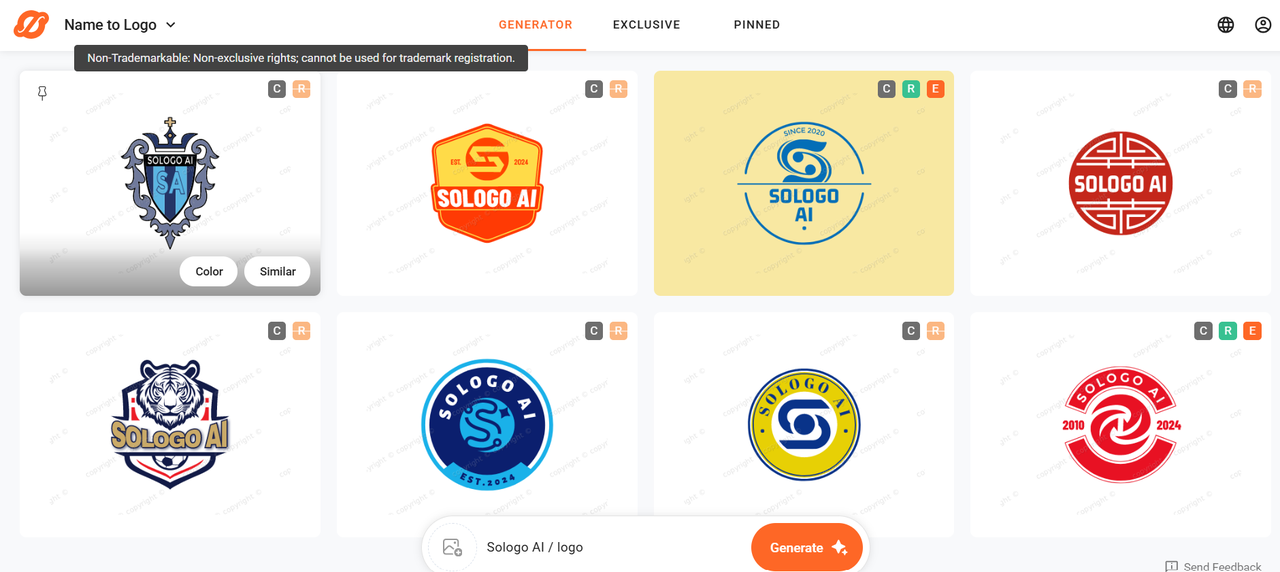
One standout option is Sologo.AI—a specialized AI logo generator designed specifically for entrepreneurs who want trademark-friendly designs. Unlike general-purpose tools, Sologo.AI uses proprietary training data and includes built-in originality filters to reduce the risk of unintentional similarity to existing marks. Here, C means the logo can be used for commercial purposes, and R means it is eligible for trademark use. If R is green, the logo is safe to use and can be registered as a trademark. If R has a slash, it means there is a risk of trademark infringement, so using or registering that logo could lead to legal issues.
Step 2: Create a Distinctive Logo
Aim for something unique. Avoid overly common symbols (e.g., a simple apple, a globe, or a coffee cup) unless you add highly distinctive elements.
Step 3: Conduct a Comprehensive Trademark Search
Before you spend money on an application, search:
- USPTO TESS database
- State trademark databases
- Common-law searches (Google, social media, domain names)
- Professional clearance search (recommended for high-value brands)
Tools like Trademarkia, Namecheap, or services from attorneys can help.
Step 4: File the Application
You have two main options:
- Use-based (1(a)): If you're already using the logo in commerce.
- Intent-to-use (1(b)): If you plan to use it soon.
You'll need:
- A clear drawing of the logo (black-and-white or color)
- Description of goods/services (International Classes)
- Specimen of use (photos, website screenshots, packaging, etc.)
Step 5: Respond to Office Actions
About 60-70% of applications receive at least one office action (refusal or requirement). Common issues include descriptiveness or likelihood of confusion. You can usually overcome these with arguments or amendments.
Step 6: Maintain Your Trademark
File a Declaration of Use between years 5-6 and renew every 10 years.
Why Consider Sologo.AI for Creating a Logo You Might Want to Trademark?
Sologo.AI is an AI-powered logo generator that includes features aimed at helping users create designs suitable for branding and potential trademark use:
- Logos are generated using a proprietary dataset of verified fonts, graphics, and elements designed to reduce similarity to well-known existing marks.
- Lifetime commercial use rights (once downloaded under a paid plan, your logos retain commercial licensing even if the subscription ends).
- Outputs include professional vector formats (SVG, EPS), which are commonly required for trademark applications (e.g., as specimens with the USPTO).
Each generated logo is clearly labeled with its licensing type:
- C (Commercial Use): Suitable for general commercial purposes, including business materials, websites, products, and marketing.
- R (For Trademarking): Designed with trademark registration in mind (e.g., more distinctive and less likely to conflict based on platform checks), though success depends on official trademark office review.
- NR (Non-Trademarkable): Intended for general or personal use only, not recommended for trademark applications.
- Exclusive: Available for purchase on select logos—once bought, the design is removed from the platform and granted exclusive rights to you (no one else can access or use it).
Important note: While Sologo.AI provides commercial licensing and tools to support logo creation, it does not offer trademark registration services. You are responsible for conducting your own trademark search (e.g., via USPTO database or a professional search), filing the application, and handling any legal process through an attorney or trademark office. Always verify availability and distinctiveness independently before investing in protection—AI-generated designs can still face challenges if they resemble existing marks.
Final Thoughts: Go Ahead—Trademark Your AI Logo
In 2026 and beyond, AI-generated logos are not just acceptable—they're becoming the norm for startups and small businesses. As long as your design is distinctive, you've done proper clearance searches, and you're using or intend to use the logo in commerce, you can and should trademark it.
Tools like Sologo.AI make the process faster, safer, and more affordable than ever. Start creating your logo today, run your searches, and file your application with confidence.
Your brand deserves the strongest possible protection—don't let outdated myths about AI hold you back.
Ready to create a trademark-ready logo? Try Sologo.AI for free and see how easy it can be to build a brand that's legally yours.
FAQs: Trademarking AI-Generated Logos
Q1: Can I trademark an AI-generated logo?
Yes, it is possible in many cases, but with important caveats. The USPTO does not prohibit AI-generated logos outright. What matters is whether the final mark is distinctive, used in commerce, and does not conflict with existing trademarks. However, if the logo is purely AI-generated with minimal human input, it may face challenges in proving sufficient originality or human authorship for related protections. Always conduct a thorough clearance search and consider adding significant human creative elements, like manual adjustments, custom typography to strengthen your application.
Q2: Does the USPTO know if a logo was made by AI?
No, the USPTO does not ask or track whether AI was used in creating a logo. The application forms contain no such question, and examiners focus solely on the mark's distinctiveness, commercial use, likelihood of confusion with existing marks, and compliance with rules—not the creation method.
Q3: Can I copyright an AI-generated logo?
Generally no. Under current U.S. Copyright Office guidance, works created solely by AI without meaningful human creative input lack the required human authorship and are not eligible for copyright protection. However, if you make substantial human edits, additions, or creative decisions, like manual redesign, combining elements, or significant artistic input, the resulting work may qualify for copyright.
Q4: What if my logo looks like someone else's?
You risk rejection, opposition during examination, or future infringement claims—even if unintentional. AI tools can sometimes produce designs that unintentionally resemble existing marks. To minimize risk, always conduct a comprehensive clearance search (USPTO database + state/common-law searches, ideally with a professional) before filing or using the logo commercially.
Q5: How much does it cost to trademark a logo?
USPTO federal filing fees start at $350 per class of goods/services (2026 TEAS Standard electronic rate). For a simple case with an attorney, total costs typically range from $800–$2,500 (including search and filing). Maintenance/renewal fees apply every 5–10 years.
Q6: What is the cheapest way to trademark my logo?
The absolute cheapest option is usually filing a state-level trademark application (fees often $50–$150 per state, depending on location). However, state trademarks only protect you within that state and offer limited enforcement compared to federal registration. For broader, stronger protection, especially if you plan to sell nationwide or online, the federal USPTO route is generally more cost-effective long-term despite the higher upfront fee.
Q7: Is it safe to use free AI logo generators?
Not always. Many free tools restrict commercial rights, retain ownership of the designs, impose usage limitations, or generate generic/similar logos that increase conflict risk. Always read the terms of service carefully. Paid, specialized platforms like Sologo.AI typically provide clearer commercial licensing, vector files, and options labeled for trademark potential, making them safer for serious branding.
Q8: How to avoid copyright issues with AI-generated logos?
To reduce copyright risks:
- Use tools trained on public domain, open-source, or licensed datasets.
- Avoid generators known to include pirated or high-risk copyrighted material in training.
- Add significant human creative input to the final design.
- Conduct clearance searches to ensure the output doesn't closely mimic protected works.