Launching a startup is chaotic, and your logo is often treated as an afterthought. But in reality, it’s the face of your entire brand—and often the first thing customers, partners, and investors judge you by. Before anyone reads your pitch or uses your product, your logo has already shaped how they see your brand. A weak, generic, or poorly designed logo can quietly destroy your credibility before anyone even uses your product.
Yet most startups make the same mistakes: they rush the process, cut corners, or try to do it themselves. The result is a logo that looks forgettable, unprofessional, or painfully generic.
In this article, we’ll break down the 12 most common startup logo mistakes and show you exactly how to fix them—so your logo can grow with your brand, not hold it back.
Let’s dive in.
12 Common Startup Logo Mistakes and Optimization
Mistake 1: Not Pre-Planning or Researching Before Designing
Jumping straight into sketching without a clean brief, competitor analysis, audience understanding, or market research leads to logos that looks pretty but irrelevant—disconnected from your brand story, values, or customers. When startups pivot, a rushed logo quickly becomes a liability.
Optimization: Start with strategy. Write a one-page brief: Who is your audience? What emotions do you want to evoke? Who are your competitors?What do your competitors’ logos do well/poorly? Research trends without chasing them.
Mistake 2: Over-Relying on Free Logo Makers and Generic Templates
It's tempting. You're bootstrapping, cash is tight, and tools like Canva, Looka, or Hatchful promise a professional-looking logo in minutes for free or close to it. You plug in your name, pick a template, tweak a few colors, and boom—done.
The problem? These tools spit out designs based on popular templates and stock elements. Your "unique" logo looks like hundreds of other startups. In competitive niches like SaaS, fintech, or e-commerce, generic designs make you invisible.
Worse, these logos are often hard to trademark because they're not original enough. And when you eventually scale and want a custom refresh, you're starting from scratch—wasting time and money.
Optimization: Platforms like 99designs or Upwork let you hire freelancers for $300–$1500, getting truly bespoke results. If budget is zero, at least use the tools as inspiration, then hand off to a designer to customize heavily.
Mistake 3: Overcomplicating the Design with Many Elements
You want your logo to say everything: your product, your mission, your industry, your personality. So you cram in icons, gradients, shadows, multiple fonts, and clever hidden meanings.
The result is a cluttered mess that looks great on a big screen but turns to mush when scaled down to a favicon, app icon, or business card. Startups especially suffer because they need logos everywhere—social profiles, pitch decks, merch, ads.
Complex designs also confuse viewers. People remember simple shapes faster, like Nike swoosh or Apple bite.
Optimization: Follow the "less is more" rule. Aim for 1–2 core elements at most, such as a symbol paired with a wordmark or just stylized text. Strip away anything non-essential. Test by squinting—if you can't make it out, simplify.
Great examples: Airbnb's simple "A" symbol or Stripe's clean wordmark. They convey sophistication without overload. Sketch variations, then refine to the simplest version that still captures your essence.
Mistake 4: Ignoring Scalability and Versatility
You design on a big monitor at full size. It looks perfect. But then you slap it on a mobile app icon (32x32 pixels), black-and-white invoice, or dark-mode website—and it falls apart. Lines blur, details vanish, colors clash.
This is a huge startup logo design mistake because your brand appears on tiny favicons, embroidered hats, billboards, and everything in between. If it doesn't work small or in one color, you're limiting your options.
Optimization: Always test versatility early. Create versions: full color, monochrome, inverted, small size as low as 16px. Use vector formats (SVG, AI, EPS) for infinite scaling without quality loss. Tools like Adobe Illustrator help.
Check on real contexts: phone screens, social avatars, merch mocks. A versatile logo adapts effortlessly, saving headaches later.
Mistake 5: Designing for Today Instead of the Future
Gradients were hot in 2020. 3D effects and neon popped in 2022. Now in 2026, skeumorphism is creeping back, and AI-generated flourishes are everywhere.
But trends date fast. What looks cutting-edge today screams "2024 relic" in three years. Startups pivot often—your logo shouldn't force a full rebrand every time a trend shifts.
Optimization: Prioritize timeless elements: clean lines, classic fonts, simple shapes. Look at enduring logos like FedEx (arrow illusion, 1994) or Twitter's bird (pre-X). They avoid fads.
Ask: "Will this still look good in 10 years?" If unsure, tone down trendy effects. Timeless design builds lasting equity.
Mistake 6: Making Poor Color Choices
Colors evoke emotion—blue builds trust (banks/tech), red signals energy (food/fast). But many startups pick colors because "they look cool" or match their favorite app, ignoring psychology and accessibility.
Issues: low contrast, clashing hues, or palettes that don't reproduce well in print/B&W.
Optimization: Start with color theory. Limit to 2–3 colors. Ensure WCAG contrast ratios. Test on different backgrounds/devices. Consider your audience — eco-startup? Earthy greens; fintech? Professional blues. Least error-prone, but not optimal. Tools like Coolors or Adobe Color help create harmonious palettes aligned with your brand values.
Alternatively, opt for Sologo.AI's color palette derivation: it extracts key colors from your logo, applies AI color harmony, and lets you customize palettes in single- or bi-color modes to fit your brand aesthetic.
Mistake 7: Choosing the Wrong Fonts or Ignoring Typography Details
Fonts convey tone—serif for trust/tradition, sans-serif for modern/clean. But startups often mix incompatible fonts, ignore kerning (letter spacing), or use decorative ones that kill readability.
Bad kerning makes " kern" look like "ke rn." Poor alignment throws off balance.
Optimization: Stick to 1–2 fonts max. Use sans-serif for tech/modern vibes and serif for trust/tradition when appropriate. Pay for custom or premium fonts if your budget allows. Always optically kern—adjust spacing by eye rather than relying on auto settings. Test legibility at small sizes. Great typography can make even a simple wordmark iconic, like Google’s clean sans. For multilingual logos, use tools like Sologo.AI’s curated font library. It automatically detects the input language, e.g., Korean, Chinese, Japanese and recommends hand-selected fonts optimized for each script — ensuring perfect readability, character integrity, and stylistic harmony across global markets.
Mistake 8: Copying Competitors or Using Generic Symbols
"Let's add a rocket for growth!" "A gear for tech!" "A globe worldwide!"
These clichés flood startup logos. You blend into the noise, looking like every other player in your space.
Copying directly risks legal trouble and kills differentiation.
Optimization: Research competitors. Identify gaps—what visual territory is untapped? Brainstorm unique metaphors tied to your story/value prop.
Aim for distinctive: Slack's colorful hashtag, Dropbox's open box. Originality wins attention and trademark ease.
Mistake 9: Forgetting About Trademarks and the Future
You love the design—ship it! But is it trademarkable? Does it resonate with your target users? What if you pivot markets? Many startups overlook legal availability, cultural connotations, or long-term flexibility.
Optimization: Run USPTO/EUIPO searches early or hire an attorney. Test with real users via surveys (PickFu, friends). Design modularly—icon separable from text for evolution.
Mistake 10: Using Low-Quality Graphics
It's easy to grab a quick PNG icon from a free site or use a low-res image because it "looks good enough" on your screen. But when that logo hits print, merch, or billboards, it pixelates, blurs, or looks cheap.
Startups need logos everywhere—from app favicons to investor swag—and low-quality assets fail fast. Raster formats don't scale; they distort. This screams unprofessional and undermines trust before users even try your product.
Optimization: Always work in vector formats (SVG, AI, EPS) from the start. Vectors are resolution-independent—they look crisp at any size. Use tools like Adobe Illustrator or free alternatives like Inkscape for true scalability.
Source icons only from high-quality vector libraries (e.g., Flaticon premium, Noun Project vectors). If you're DIY-ing, export everything as vectors and test at 16x16 pixels up to poster size. High-quality vectors future-proof your logo and save redesign headaches down the line.
Mistake 11: Misusing Shapes and Visual Meaning
Shapes carry subconscious weight—curves feel friendly, sharp angles aggressive. But careless choices can create double entendres or negative associations (e.g., a shape that resembles something rude or culturally offensive).
Startups often overlook this in the excitement of a "clever" design. What seems innocent to you might alienate audiences or spark backlash online.
Optimization: Research cultural connotations of every shape and symbol. Test with diverse focus groups or tools like PickFu. Ask: "What does this remind people of?" Avoid ambiguity unless intentional and positive.
Great logos use shapes purposefully (FedEx's hidden arrow for forward motion). Be deliberate—shapes should reinforce your message, not undermine it.
Want more examples of metaphors in well-known logos? Click the blog link below.
9 Famous Logos with Hidden Meanings (and What They Teach Us About Branding)
Mistake 12: Not Proof-Reading the Logo Thoroughly
You finalize the design, love how it looks, and ship it—only to later spot a misspelled word, awkward abbreviation, or typo in your company name.
This happens more than you'd think, especially when you're rushing or emotionally attached. A misspelled logo becomes a permanent embarrassment, meme fodder, and credibility killer. For startups, first impressions matter hugely—don't let a silly oversight tank yours.
Optimization: Proofread obsessively at every stage. Have multiple people (not just you) check spelling, grammar, kerning oddities, and unintended meanings. Step away for a day, then review fresh.
Print it out large and small; view inverted or in black-and-white. Run it by non-native speakers if your market is global. Tools like Grammarly help, but human eyes catch what software misses. A proofed logo protects your reputation from day one.
A Smarter Way to Use AI Without Falling Into the Generic Trap
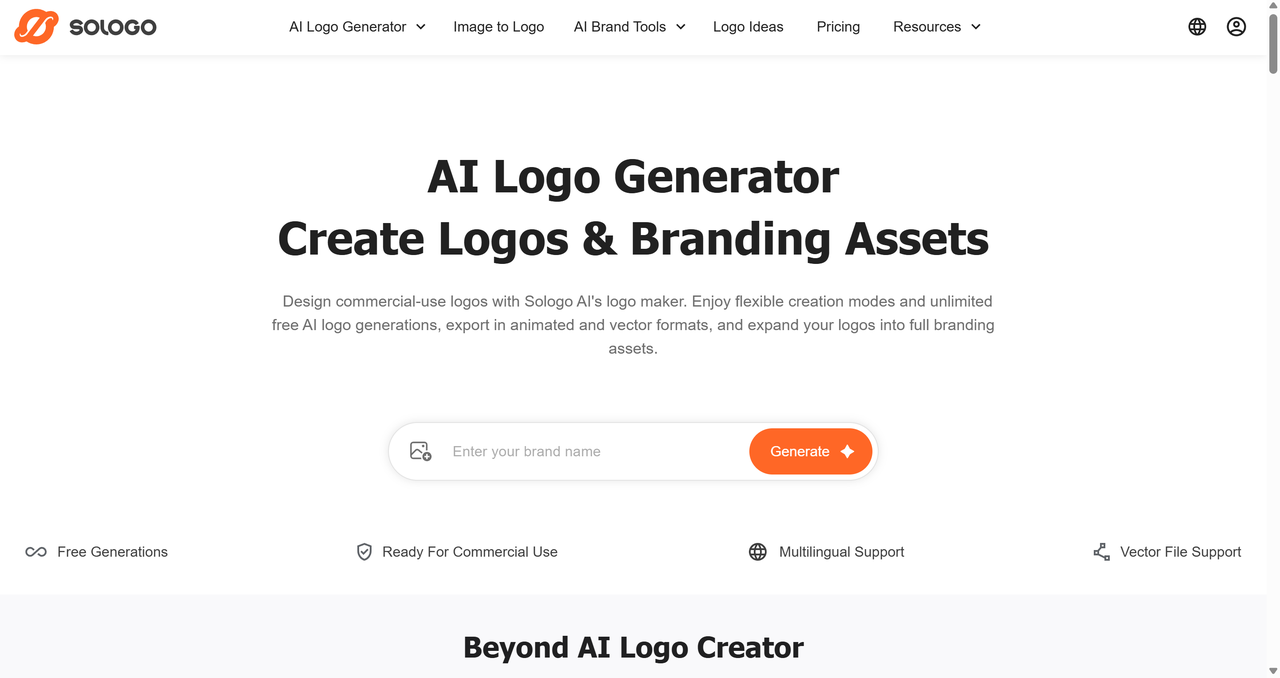
If your budget is tight and hiring a full-time designer feels out of reach while you’re still getting your startup off the ground, it’s completely understandable why so many founders turn to free or cheap logo makers in the first place. The problem is they produce generic, cookie-cutter results that make your brand look like everyone else’s, or worse, totally uninspired.
The good news? AI has come a long way, and not all AI logo tools are created equal.
Trusted by over 100,000 startups worldwide, Sologo.AI is a free AI-powered logo generator that goes far beyond generic outputs. You can create unlimited logos from just your brand name, a short description of your industry and vibe, or even upload a photo, sketch, or hand-drawn idea — and the AI turns it into a unique, professional vector design.
What sets it apart for avoiding common startup logo mistakes:
-
Originality over templates — Instead of forcing you into pre-made molds, it generates fresh concepts tailored to your input, helping you steer clear of the "everyone-has-the-same-globe-or-rocket" problem.
-
Built-in versatility — Every logo comes in high-quality vector formats (SVG, PNG, PDF) so it scales perfectly from favicon to billboard, addressing scalability issues right from the start.
-
Customization that matters — Use their online editor to tweak colors, fonts, layouts, and more with simple prompts—no design skills required. You can even animate versions for social media or pitch decks.
-
Commercial rights included — Download with clear, permanent commercial-use licenses and buyout options if needed, so you don't have to worry about trademark headaches later.
-
Bonus branding tools — Expand your logo into a full brand kit with consistent assets, mockups on business cards/merch/social posts, and multilingual support if you're targeting global markets.
The best part? You can generate and experiment for free, only paying if you need premium downloads or advanced features. It's not a magic fix-all—if you're chasing ultra-premium custom work, a pro designer is still ideal—but for most early-stage startups, it's a massive upgrade over basic Canva-style tools. It helps you create something that feels truly yours, stands out in a crowded market, and grows with you.
Canva vs. Sologo.AI: Which is better for your logo? → Click the blog link below to find out.
Ultimate Showdown: AI Logo Generator Canva vs Sologo AI – Which One Truly Delivers?
If you're guilty of Mistake 1 or worried about a few others on this list, head over to Sologo.AI and run a quick test with your brand name. You might be surprised how fast you land on a logo that actually excites you—and saves you from a costly rebrand down the road.
Final Thoughts: Your Logo Is a Long-Term Investment
Avoiding these common startup logo mistakes isn't about perfection—it's about intention. A thoughtful logo builds trust, stands out, and scales as you grow. Don't treat it as a checkbox; treat it as a foundation.
Audit your current logo against these points. If it fails several, consider a refresh. The cost of fixing early is tiny compared to rebranding later.
Your startup deserves a logo that works as hard as you do. Get it right, and it'll pay off in recognition, credibility, and growth for years to come.